5 Tips for a Restaurant Website That Actually Drives Business
Your website is more than a digital menu — it’s your host stand, your reservation desk, your 24/7 marketer, and in many cases, your guest’s very first impression. It’s working harder than any team member you’ve ever hired… if it’s built the right way.
In a world shaped by rapidly changing search behavior, Generative Engine Optimization (GEO), and AI-powered recommendations, a beautiful website simply isn’t enough anymore. Today, your site needs to perform for two audiences at the same time:
- The hungry human guest who wants clarity, ease, and confidence.
- The search engine and AI robots that need context, structure, and data.
Recently, we sat down with Marqii’s own website expert, John Cullinan, and hospitality marketer Anna Tauzin from The Good Kind to break down what restaurant operators must do right now to stay competitive online. Their verdict?
Success comes down to five must-have elements that help your guests take action — and help search engines understand and reward your content.
Let’s dig in.
1. Set the Vibe with High-Quality, Honest Visuals (Plus Alt Text)
The first moment a guest lands on your site, they’re deciding whether they want to dine with you. As Anna put it, your website is “your restaurant’s front door” — and the visuals you use determine whether guests walk in.
If you’re a dimly lit, moody steakhouse, your website shouldn’t feel like a neon juice bar. And if you’re a sunny brunch café, your photos shouldn’t feel dark or hyper-polished. Visual consistency builds trust faster than words ever could.
Your Action Item: Share the Real Deal
Guests make decisions in seconds. Use high-quality, honest photos that show:
- What the food actually looks like
- What it feels like to sit in your dining room
- What kind of experience they can expect
This isn’t the moment for AI-generated food photos. (As John joked during our session: “Your brisket shouldn’t have six fingers.”) In hospitality, authenticity wins every time.
The Technical Must-Have: Add Alt Text
Alt text is one of the easiest and most overlooked wins.
- For accessibility: Screen readers rely on alt text to describe images for visually impaired guests.
- For SEO: Search engines use alt text to understand the image — and it’s a prime opportunity to naturally include local, relevant keywords.
Example: “Close-up of our signature spicy tuna handroll topped with sesame seeds and fresh wasabi.”
Honest photos build trust. Alt text builds visibility. Together, they do a lot of heavy lifting.
2. The Core 4: Location, Hours, Menu, and Price (And Why PDFs Are a Black Hole)
When someone visits your restaurant website, they’re usually looking for one of these four things:
- Your address
- Your hours
- Your menu
- Your pricing
If that information isn’t immediately visible, you’re creating friction — and in a competitive market, friction loses guests.
Your Action Item: Make the Core 4 Unmissable
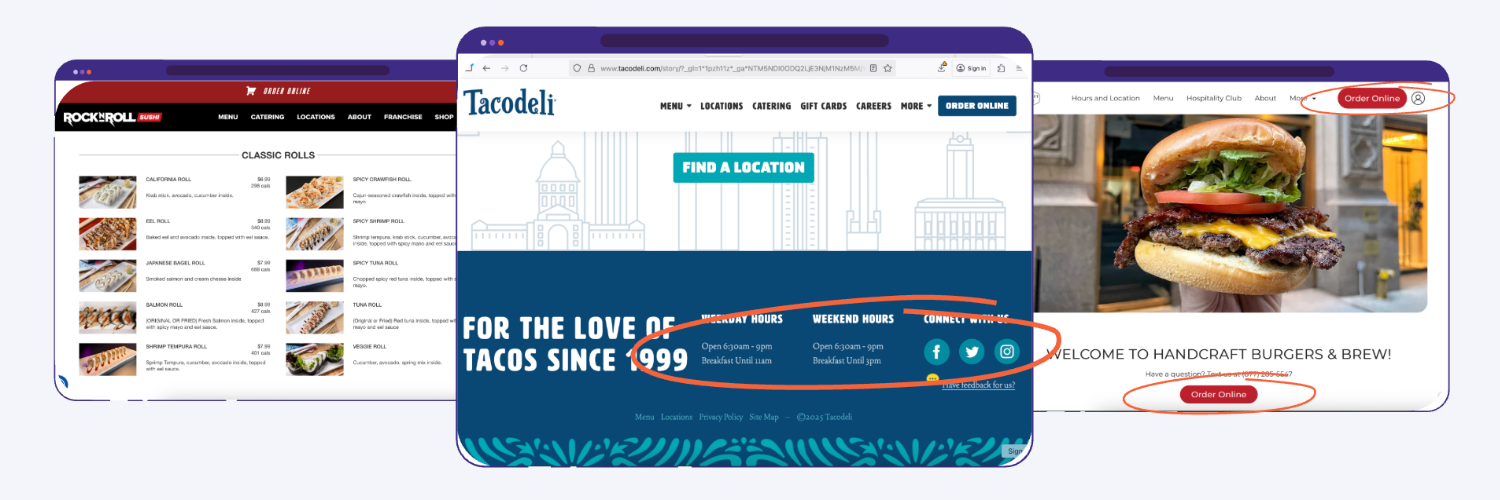
A best practice in restaurant website design is to place essential information (location, phone number, hours) in your site’s footer. That way, it appears:
- On every page
- In the same spot
- In a format that search engines can consistently read
This is fantastic for local search, because search engines reward clarity and consistency.
The Critical Requirement: Stop Using PDF Menus
We’ll say it louder for the people in the back:
PDF menus are invisible to search engines and AI agents.
Robots can’t read PDFs. They can’t parse them. They can’t extract information. Which means all the rich details about your menu — your items, prices, ingredients, dish names — disappear into a void.
If your menu exists only as a PDF, you’re handing your local competitors the SEO advantage.
The Better Way: HTML + Structured Menu Data
Type your menu directly onto the page or use a structured menu tool like Marqii Widgets. This makes every item:
- Searchable
- Crawlable
- Indexable
- GEO-friendly
If your food is your superpower, don’t hide it behind a download button.
3. Create Clear, Action-Oriented CTAs (Your Website Shouldn’t Be a Museum)
A restaurant website isn’t meant to be admired — it’s meant to be used. That starts with clear Calls to Action.
Your Action Item: Prioritize the “Next Step”
Organize your content around two flows:
Information Flow:What the guest needs to know — hours, address, menu.
Action Flow:What you want them to do — order, reserve, sign up.
Your top CTAs (like “Order Online” or “Reserve Now”) should never be buried. They should be:
- Prominent
- Consistent
- Impossible to miss
Add seasonal or timely CTAs, too — like holiday pre-orders or catering inquiries.
The SEO Bonus
Strong CTAs don’t just convert better — they help search engines understand that your website is functional and engaging. When guests click, scroll, and stay longer, search engines measure that as a signal of quality.
A clear CTA = a lower bounce rate = better search visibility. Win-win.
4. Embrace Structured Data (Schema) to Win the GEO Era
We’re officially in the age of Generative Engine Optimization (GEO). People aren’t just searching for “best tacos NYC” anymore. They’re asking questions like:
- “Where can I get a vegan sushi roll under $10 near me?”
- “Which restaurants are open past 10pm and take reservations?”
AI agents and search engines answer these questions using Structured Data, also known as Schema Markup.
What is Schema?
Schema is specialized code (microdata) placed behind the scenes of your website content that gives search engines context. It’s the language robots use to understand the relationship between the text on your page.
What Schema Does
Schema adds context to your content. It tells search engines:
- What a piece of information is
- How it relates to other information
- Why it matters
Without schema, AI has to make its best guess. With schema, AI answers confidently — with your data.
Why It’s Crucial for Menus
John shared this example:
A robot can see the text "California Roll - $6.99," but with Schema, it understands that:
- The entity is a food item.
- Its specific name is "California Roll."
- It belongs to the menu of a restaurant.
- Its price is $6.99.
This is how you win when someone asks a chatbot to find menu items by ingredient, diet, or price.
Your Action Item: Make Your Site Robot-Friendly
Schema, especially for menus, is the most powerful tool for building GEO visibility. With structured data, your website becomes the primary source — meaning search engines and AI pull information directly from you, not third-party platforms.
5. Build FAQs That Answer Your Guests’ Real Questions
If Structured Data is your technical superpower, FAQs are your content superpower.
FAQ pages capture the exact conversational questions guests type into Google Gemini, ChatGPT, or ask voice assistants every single day.
Your Action Item: Start with “The Phone Questions”
Talk to your team. What do your hosts, bartenders, and GMs get asked constantly?
- Do you take reservations?
- Do you have free Wi-Fi?
- Where’s the best place to park?
- Can I bring a large group?
These questions reduce repetitive staff conversations and feed search engines valuable context.
Add FAQ Schema
FAQs are another example of structured data. By setting up the questions and answers on your website with FAQ Schema, you are literally hand-delivering the exact conversational information that AI engines are trying to find. This gives you primary source authority and ensures the answers that pop up in search results are accurate and favorable to your brand.
It’s one of the easiest ways to earn rich results in search — and one of the strongest GEO strategies available.
A Menu Tip While We’re Here
Fun dish names are great. Confusing dish names are not.
Bad for SEO:The Green Machine
Good for SEO AND guest clarity:Matcha Latte (The Green Machine)
Use descriptive, searchable terms in the name, and put the creative flair in the description.
Final Thoughts: Hospitality First, Robots Second
The best restaurant websites strike a balance between:
- Warm, human hospitality guests can feel
- Clean, structured data robots can understand
Ignoring these fundamentals means letting competitors win guests you could have earned. And not because their food is better, but because their website speaks both languages.
Ready to Simplify Website Management and Win Local Search?
For single-location restaurants, simple tools like Marqii Widgets can add schema and menu structure instantly.
For multi-location brands, though? The work multiplies fast. Updating menus, hours, address info, pages, and schema across every location becomes a full-time job.
That’s exactly why we built Marqii Host.
Marqii Host Handles the Hard Stuff:
- Automated, SEO-optimized location pages for every restaurant
- Instant updates across all pages from your Marqii dashboard
- Fully implemented structured data on menus, hours, reviews, and business info
- Consistent, accurate data everywhere your guests search
If you’re tired of juggling manual website updates or watching competitors outrank you, it’s time to let automation take the wheel.
Stop rebuilding location pages — start running restaurants.
Schedule a demo with our team and transform your local SEO strategy.
And if you’re curious how your current site is performing, John recommends two quick checks:
- Google PageSpeed Insights — for load time and performance
- Schema.org Validator — to see what data search engines are reading
For the full breakdown straight from John and Anna themselves, watch our Live Session today!