
AI Just Recommended Your Competitor. Here’s Why.
What restaurant operators need to understand about how AI models decide who gets found and who gets skipped.

What restaurant operators need to understand about how AI models decide who gets found and who gets skipped.
Something new is happening before a guest ever walks through your door.
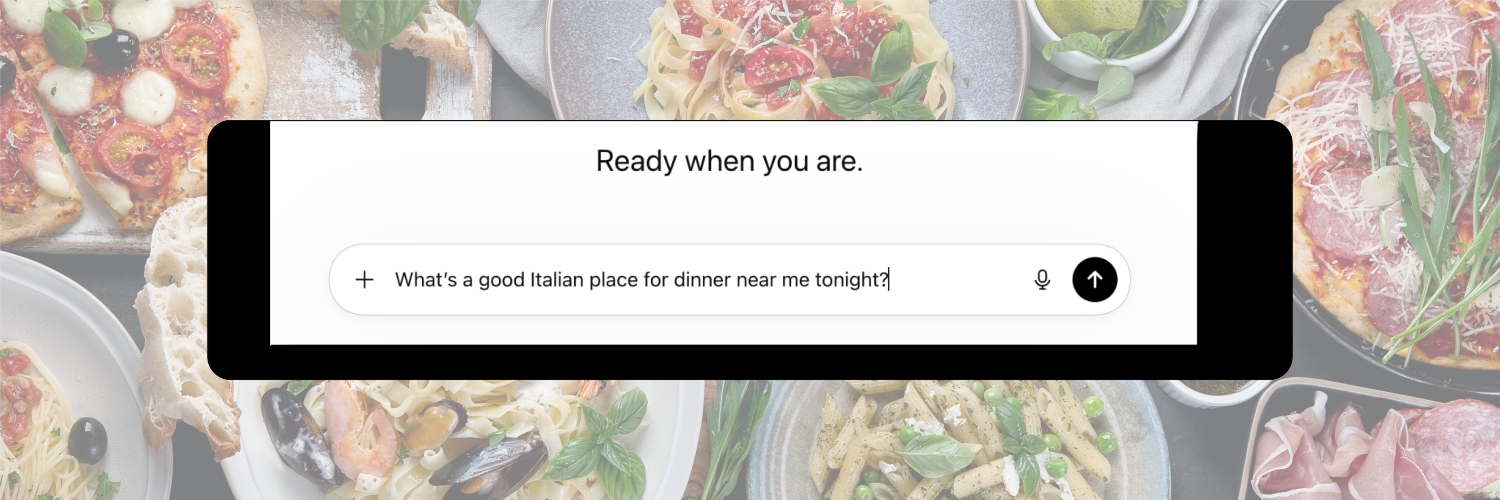
They’re not opening Yelp. They’re not typing into Google Maps. They’re asking ChatGPT, Gemini, or Claude: “What’s a good Italian place for dinner near me tonight?”
In about three seconds, an AI model synthesizes data from dozens of sources, picks one or two restaurants, and presents them as the answer. No list of ten options. No paid ads competing for position. Just a recommendation.
If your restaurant isn’t in that recommendation, you don’t get a runner-up mention. You simply don’t exist in that moment.
This is the new discovery landscape. And most multi-unit operators are completely unprepared for it.
The Numbers Behind the Shift
AI-powered discovery is not a future trend. It’s a current reality with a growth curve that demands attention now.
The trajectory is clear. AI isn’t replacing search. It’s sitting on top of it, filtering results before a guest ever sees them. In foodservice, where intent is hyper-local and decisions happen fast, that filter is increasingly decisive.
Among AI platforms, ChatGPT dominates by volume, owning 84.2% of all AI referral sessions and growing 3.26x year-over-year. Claude posted 12.8x year-over-year referral growth, the fastest-growing AI model alongside Copilot. Gemini grew 388% year-over-year in referral traffic between September and November 2025.
Sources: Previsible State of AI Discovery Report, 1.96M sessions, Dec 2025 | Digiday / Similarweb, Dec 2025
How AI Models Actually Decide Who to Recommend
Here is where most operators get it wrong.
AI recommendations feel mysterious. They’re not. The models aren’t making judgment calls based on which restaurant has the best vibe or the most Instagram followers. They’re pulling structured data from sources they can access and trust. Most of those sources are ones you already control.
BrightLocal studied how AI models source answers for local business queries and found that Yelp appears as a source in 33% of all AI searches, making it the most consistently cited directory across ChatGPT, Gemini, and Perplexity for restaurant queries. Foursquare, which powers much of ChatGPT’s location data through a direct partnership with OpenAI, and MapQuest are also heavily leveraged across platforms.
BrightLocal AI Search Sources Study, 2025
A separate analysis by Conductor across 10 major industries found that 87.4% of all AI referral traffic flows from ChatGPT specifically. And a citation study analyzing 6.8 million AI responses across foodservice queries found that 86% of all restaurant citations came from sources brands already control: their own websites, listings, and reviews.
Conductor / Digiday, 2025 | Yext AI Citation Study, 6.8M citations, 2025
The data is consistent across sources: the footprint you have built, or failed to maintain, is exactly what AI is reading.
Not All AI Models Think the Same Way
ChatGPT, Gemini, Perplexity, and Claude don’t source information identically. Optimizing for one and ignoring the others creates blind spots that compound across a multi-unit portfolio.
A restaurant brand that keeps its Google Business Profile accurate but ignores Yelp is visible on Gemini and invisible on ChatGPT. A brand with strong reviews but a poorly structured website wins on Perplexity and loses on Gemini. And a brand ignoring Claude is leaving the highest-converting AI referral channel on the table, even as its volume keeps growing.
Visibility in the AI era requires coverage across all four surfaces: listings, website, reviews, and user-generated content. Each model weights them differently. There is no single lever. It is a portfolio problem.
Location Pages: The Underbuilt Asset AI Depends On
One of the most overlooked gaps in multi-unit restaurant brands is the location page. It matters more now than it ever has.
When a guest asks ChatGPT, “best burger spot near downtown Nashville,” the model doesn’t just look for your brand. It looks for a specific, structured, crawlable page that tells it where you are, what you serve, what your hours are, and what real guests have said about that location. Without that page, even a well-known brand can be invisible.
AI recommendation systems treat well-built location pages as trusted entities. They use the page to confirm that your business name, address, and hours match what they see in third-party directories. They pull review snippets, menu language, and cuisine attributes directly from the page to match your location to the query. If the page is missing, generic, or mismatched to your listing data, the model loses confidence and moves on.
What makes a location page AI-readable in 2026:
- Accurate, unique NAP data for each location (not copied from a headquarters page)
- Current hours, including seasonal and holiday changes, updated in real time
- Schema markup (LocalBusiness, Menu, FAQPage) so AI systems can parse your data without guessing
- Location-specific content and review integration, not a generic brand description pasted across 50 pages
- Consistent match between your location page data and your third-party listing data across Yelp, Google, DoorDash, and beyond
Each location in a multi-unit portfolio should have its own dedicated page built to that standard. One brand page covering 50 locations is not a substitute. AI systems don’t recommend brands. They recommend specific locations. If a location doesn’t have a page that clearly identifies and describes it, the model has nothing to cite.
Search Engine Land, Location Page SEO Guide | Single Grain, Location Pages for AI Recommendations
The Quality of AI Traffic: Why It Matters Even More Than Volume
The volume of AI-referred traffic is still modest relative to organic search. But the quality signals are striking, particularly for a high-intent category like restaurants.
Someone asking ChatGPT, “Where should I eat tonight near me?” is not browsing. They’ve already decided to go out. They’re asking for a specific answer. That is the highest-intent moment in the guest acquisition funnel. The guest who arrives via an AI recommendation has already been pre-sold on your restaurant before they ever visit your website.
That context is why Claude referrals convert at 16.8%: nearly 10 times the rate of a standard Google organic visit.
The Invisible Tax on Multi-Unit Brands
For single-location operators, listing inaccuracy is a manageable problem. For multi-unit brands, it compounds silently across every location in the portfolio.
Consider a 50-location casual dining brand where 30% of locations have at least one material data error: wrong hours, a missing menu link, or an outdated address. In traditional search, that creates friction. In AI search, it creates invisibility. An AI model querying a restaurant for a specific neighborhood doesn’t surface a listing it can’t confidently parse. It moves to the next option.
There is no such thing as “close enough” in AI recommendations. The model either cites you or it doesn’t.
That 30% location error rate, conservative by industry standards, means roughly 15 locations in a 50-unit brand are being systematically skipped by AI models at exactly the moment a high-intent guest is looking for a recommendation. Those aren’t impressions lost. Those are guests who found someone else.
The Discovery Connection
In the first post in this series, we established that restaurants lose 45% of their loyal customer base every year to natural churn and that replacing those guests requires a steady supply of new first-timers converting through the funnel.
AI search is becoming the primary entry point for first-time users. Unlike a Google ad or a social post, AI recommendations carry an implicit endorsement. The model chose your restaurant. That credibility is built into the recommendation.
The full picture:
- 527% year-over-year surge in AI-referred discovery sessions (Previsible / Search Engine Land, 2025)
- 45% of consumers now use AI for local business recommendations, up from 6% one year ago (BrightLocal, 2026)
- 87.4% of all AI referral traffic flows through ChatGPT, making listing accuracy on its source directories non-negotiable (Conductor / Digiday, 2025)
- 16.8% conversion rate for Claude-referred visitors, the highest of any channel studied (First Page Sage, 2026)
- 12.8x year-over-year referral growth for Claude, the fastest-growing AI model in the landscape (Previsible, 2025)
What This Means for Multi-Unit Operators
The AI recommendation moment is not something you can buy your way into. There is no paid placement in a ChatGPT response. There is no bidding on position in Perplexity or Claude. You either have the structured, accurate, distributed data these models require or you don’t.
For multi-unit brands, this is both a risk and an opportunity. The risk: if your listing data is inconsistent across locations, your AI visibility will also be inconsistent, and you won’t see it in any dashboard you’re currently looking at. The opportunity: Brands that invest in listing accuracy, location page quality, review volume, and structured web content today are building an AI visibility advantage that compounds over time.
The guest is already asking the question. The only variable is whether your restaurant is the answer.
Want to know how your locations show up in AI search?